

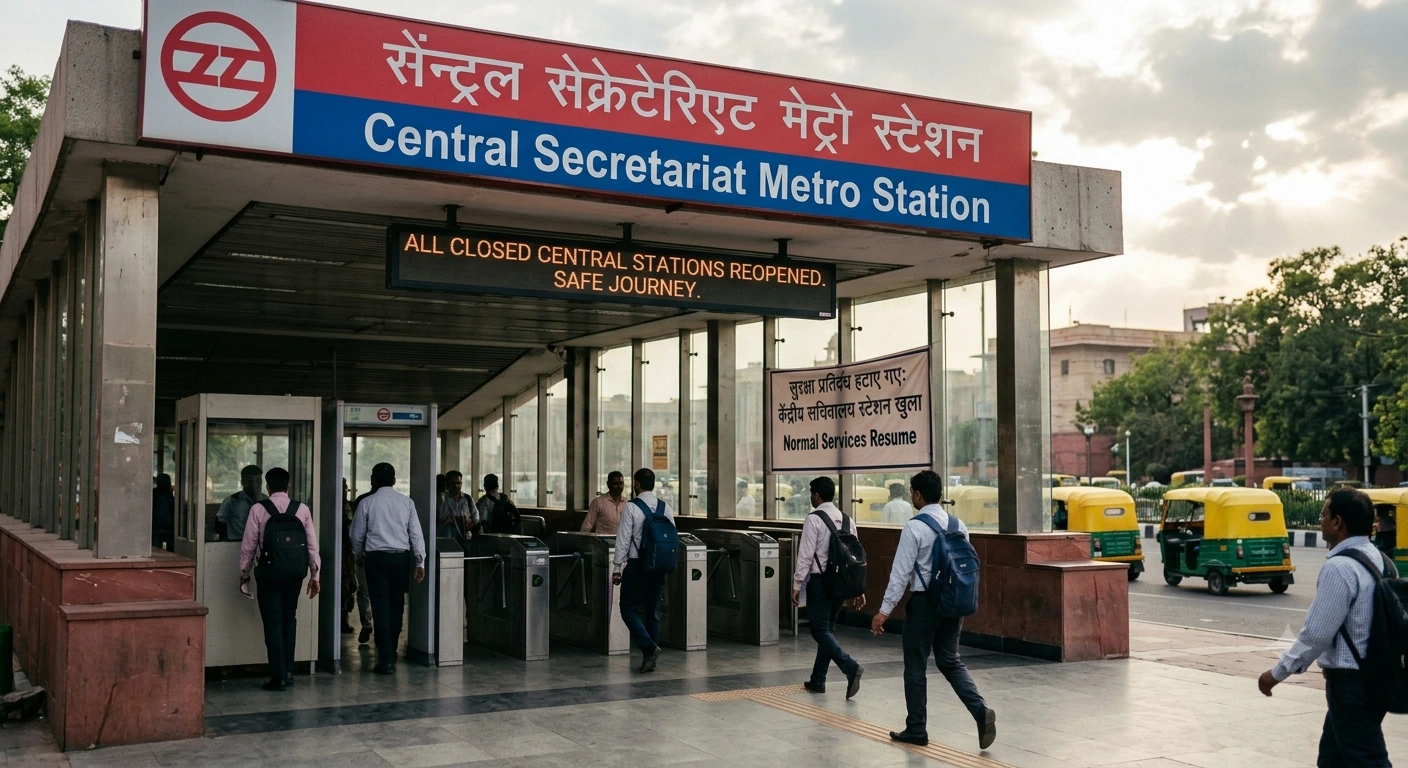
NEW DELHI — The Delhi Metro Rail Corporation (DMRC) reopened all previously closed central Delhi metro stations on Thursday, restoring metro services across the national capital’s core after nearly a week of partial shutdowns linked to security concerns near Jantar Mantar.
The reopening follows a gradual easing of security restrictions in the area, allowing transit authorities to resume operations at stations including Central Secretariat, Mandi House, Pragati Maidan, and Jantar Mantar, which had been closed to passengers since early last week. DMRC officials confirmed that all lines passing through central Delhi are operating normally, with train frequencies returning to standard intervals.
Commuters reported disruptions to their daily routines during the closure period, particularly office-goers and students. “It was a nightmare trying to navigate the city without the metro,” said Priya Sharma, a marketing executive who works in Connaught Place. “The alternative transport options were overcrowded, and it added nearly an hour to my commute every day.”

The protests near Jantar Mantar led authorities to impose temporary security barricades and close several metro stations as a precautionary measure. While the specific cause of the demonstrations was not officially disclosed, sources indicated they were related to a regional political issue. The closures affected thousands of passengers daily, particularly those traveling between Delhi’s eastern and western corridors.
Transport experts noted that the reopening reflects coordination between law enforcement and transit agencies. “This shows how urban mobility can be restored once security concerns are addressed,” said Dr. Rajiv Mehta, a transportation policy researcher at Jawaharlal Nehru University. “It also highlights the vulnerability of critical infrastructure to civil unrest.”

DMRC issued a statement urging passengers to follow COVID-19 protocols, including mask-wearing and social distancing, as ridership returns to pre-closure levels. The corporation advised commuters to plan journeys in advance due to anticipated high footfall at reopened stations.
The central Delhi metro network, one of the most heavily used segments of the city’s rapid transit system, serves millions of passengers weekly. Its closure had effects across the entire city, with many relying on buses, auto-rickshaws, and private vehicles, contributing to increased traffic congestion on arterial roads.

With services now fully restored, DMRC expects ridership to normalize within the next few days. Officials indicated they are reviewing contingency plans for future security-related disruptions.
The reopening occurs as Delhi continues to address impacts from recent civil unrest and ongoing public health concerns. Commuters have welcomed the return of metro services that connect central areas of India’s capital.

Frequently Asked Questions
Why were Delhi Metro stations near Jantar Mantar closed?
Several central Delhi metro stations were temporarily closed as a security precaution following protests near Jantar Mantar. The exact cause of the protests was not officially disclosed.
Which Delhi Metro stations were reopened?
All previously closed central Delhi metro stations have been reopened, including Central Secretariat, Mandi House, Pragati Maidan, and Jantar Mantar, restoring full metro connectivity.
Are Delhi Metro services running normally now?
Yes, DMRC has confirmed that all metro lines passing through central Delhi are operating normally with standard train frequencies after the reopening of all closed stations.
How did the metro closure affect commuters?
The closure disrupted daily commutes for thousands of passengers, forcing many to rely on buses, auto-rickshaws, and private vehicles, which led to increased traffic congestion in central Delhi.